
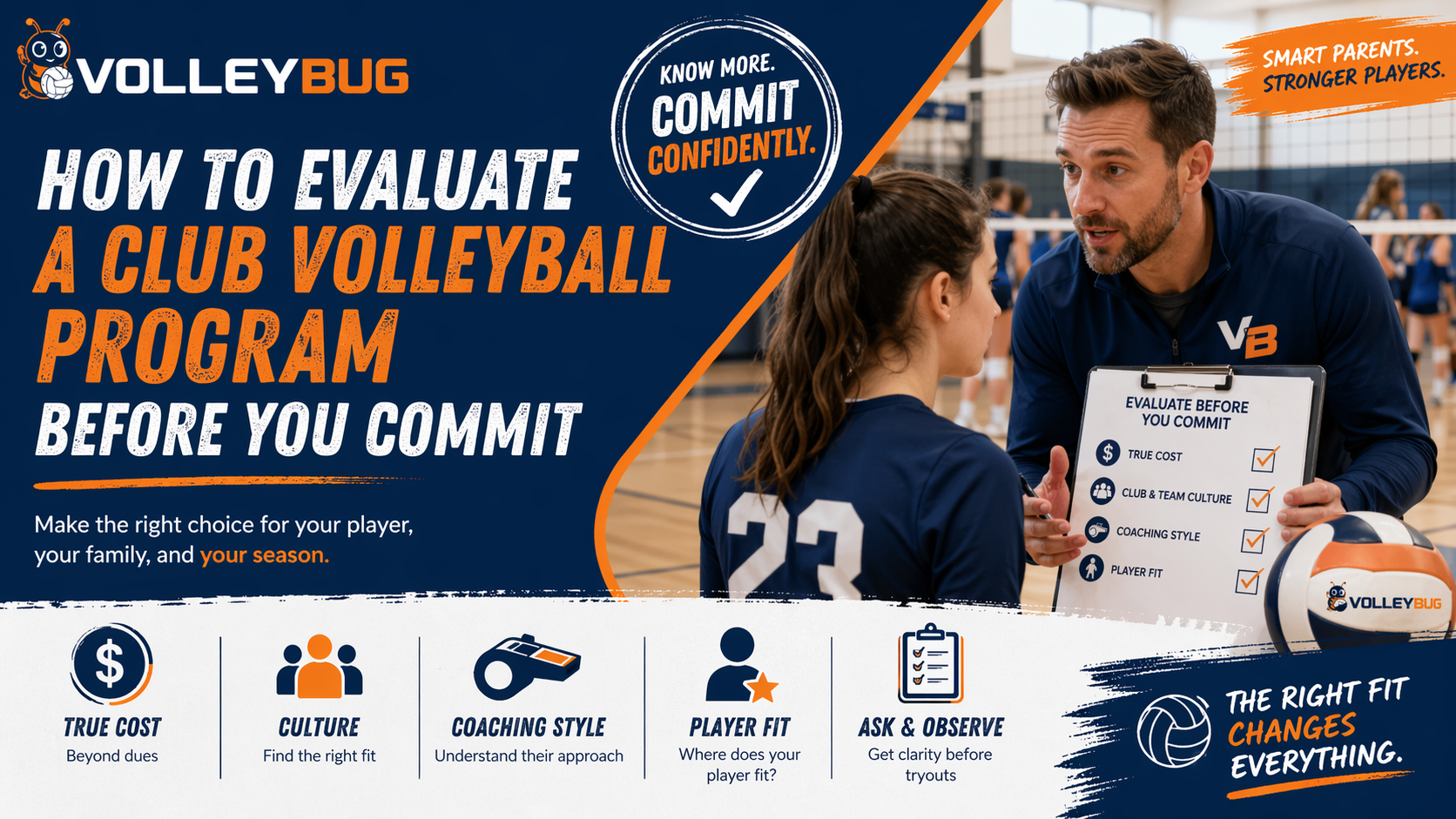
Club volleyball is very different from school volleyball, and one of the biggest differences is this:

You get to choose the coach.
In school volleyball, athletes are assigned based on their school. In club volleyball, families are making an intentional decision about where their athlete will train, who will coach them, and what kind of experience they will have for the next 6 to 8 months.
That decision matters.
Club volleyball is a major commitment of both time and money. Between dues, travel, hotels, tournament weekends, uniforms, and the endless "extras," families can easily invest thousands of dollars into a single season.
That is exactly why it is so important to know what you are getting and what you are getting into before you sign the commitment paperwork and pay your first deposit.
Once the season starts, changing clubs is difficult, expensive, and emotionally draining for both parents and athletes.
The goal is not just to find a club. The goal is to find the right club.
Let’s walk through how experienced club parents evaluate a program before committing.
Step 1: Get the TRUE Cost of the Season Before You Commit
The biggest mistake new club parents make is only asking:
“How much are dues?”
That is never the full answer.
Club dues are just the starting point.
You need the real total season cost.
Ask for a complete breakdown that includes:
Club Dues
This includes practice time, coaching, tournaments, uniforms, admin fees, and sometimes recruiting support depending on age.
Ask:
- What exactly is included?
- What is billed separately?
- Are there fundraising requirements?
- Are there surprise assessments during the season?
Some clubs advertise lower dues but make up for it later with hidden costs.
Always ask for the full picture.
Travel Costs
Travel gets expensive fast.
Ask:
- How many travel tournaments are expected?
- Which ones require flights?
- Which are drivable?
- How many nights are required for each trip?
Some teams travel heavily. Others stay local.
That difference can mean thousands of dollars.
Stay and Play Hotel Costs
This one catches families off guard.
Many tournaments use Stay and Play requirements, meaning your team must book through specific hotels selected by the tournament.
These are often more expensive than normal booking options.
Ask:
- Which tournaments require Stay and Play?
- What is the average hotel cost?
- How many nights are expected?
Do not assume you can just use points or find a cheaper hotel nearby.
Usually, you cannot.
Meals
Convention center food is basically airport food with volleyball prices.
It is expensive.
Tournament weekends often include:
- breakfast on the run
- convention center lunches
- team dinners
- late-night fast food after long days
Multiply that by 2–3 days and several travel weekends. It adds up quickly.
Ask veteran parents what a normal weekend budget looks like. They will tell you the truth.
Team Bonding Events
Some teams love team dinners, holiday parties, matching gifts, senior baskets, and extra bonding activities.
These can be great for culture. They also cost money.
Ask:
- How often do they happen?
- Is participation expected?
- What is the average parent spending?
You want to know if this is occasional or basically a second monthly payment.
Tournament Admission Fees and Parking
This sounds small until it happens every weekend.
Expect:
- Daily spectator admission fees
- Weekend passes
- Parking garages
- Cash-only parking lots
- Venue fees
For families attending every tournament, this becomes a real budget line.
The Dreaded Tournament Hoodie
Every volleyball parent knows. There will be a tournament hoodie, probably several. Warm-ups, backpacks, spirit wear, parent shirts, custom jackets, senior gifts, team bags…
Nobody talks about this in the contract. But everyone buys it.
Budget for it. Because somehow, everyone ends up with the hoodie.
Step 2: Evaluate Club Culture, Team Culture, and Coaching Style
Talent matters.
But culture decides whether your athlete thrives.
You are not just choosing a gym.
You are choosing people.
Start With the Club Director or Owner
The club director matters more than most parents realize.
During the season, they will either be your greatest advocate or your biggest frustration.
They handle:
- coaching issues
- team placement concerns
- conflict resolution
- recruiting support
- financial policies
- disciplinary decisions
Pay attention to how they communicate.
Ask yourself:
- Are they honest?
- Are they defensive?
- Do they lead with development or politics?
- Do they care about athletes or just rosters?
Trust your instincts here.
Parents usually know faster than they admit.
Understand the Team Culture
Not every team has the same goals.
And that matters.
Ask:
Are They Realistically Chasing a Bid?
Some teams are built to compete for national bids.
Others are developmental teams focused on growth.
Neither is wrong.
But they are very different experiences.
If a team is chasing a bid, coaching decisions become much more performance-driven.
Playing time gets tighter.
Mistakes matter more.
Winning becomes a major factor.
You need to know if that matches what your athlete wants and needs.
Where Does Your Athlete Fall on the Need vs Want Scale?
This is the hard conversation.
Every coach has players they need.
Every coach has players they want.
Needed players affect the system.
Wanted players are valuable but replaceable.
Ask yourself honestly:
Is your athlete a primary piece of the team plan?
Or are they depth for the team?
This affects:
- playing time
- position flexibility
- patience during mistakes
- development opportunities
Honest expectations prevent painful surprises.
Identify the Coaching Style
Every coach teaches differently.
None of them is automatically right or wrong.
The question is whether the style fits your athlete.
Is Your Coach a Yeller?
Some coaches have big voices.
That alone is not the problem.
Look deeper.
Pay attention to:
- tone
- message content
- body language
- facial expressions
- how they act when they think nobody is watching
Are they demanding and clear?
Or are they emotionally unstable?
There is a huge difference.
Your athlete will feel it.
The Supporter and Encourager
Some coaches lead with confidence-building.
Their focus is:
- mindset
- encouragement
- belief
- helping athletes stay mentally strong
These coaches can be incredible for players who need confidence and emotional support.
But sometimes athletes also need stronger technical correction.
Balance matters.
The Fundamentals-Focused Coach
These coaches live in repetition.
Footwork.
Platform angles.
Arm swing mechanics.
Reading the game.
They care deeply about individual development.
For younger athletes, especially, this is often the best long-term investment.
Skill development wins over hype every time.
The Systems Strategist
These coaches think like chess players.
They focus on:
- rotations
- matchup advantages
- lineup decisions
- exploiting opponent weaknesses
They are trying to win the match strategically.
This is excellent for advanced athletes, but can frustrate players who need more individual teaching.
The Tools-in-the-Toolbox Coach
This coach asks one question:
Can this player do the job?
If yes, they play.
If no, next player.
Simple.
This style is common at high-level clubs chasing bids.
It is not personal.
It is performance.
Families need to understand that before joining.
Step 3: Determine Where Your Player Falls Before Tryouts
This is where smart parents get clarity.
Before tryouts.
Not after.
Questions to Ask
Ask respectfully, not emotionally.
Good questions include:
- What qualities do you value most in this position?
- What separates your starters from your depth players?
- What skills does my athlete need most to improve right now?
- How do you handle player development during the season?
- How do you communicate expectations around playing time?
- What does success look like for this team?
These questions reveal far more than:
“Will my daughter start?”
Do not ask that.
Ask better.
Behaviors to Observe
Watch practice.
Watch the sidelines.
Watch warmups.
Watch what happens after mistakes.
Observe:
- Who gets corrected?
- Who gets ignored?
- Who gets second chances?
- Who gets trusted in pressure moments?
- How does the coach respond to failure?
- How do teammates treat each other?
Behavior tells the truth faster than words.
Always.
Final Thoughts
Choosing a club is not about the logo on the jersey.
It is about fit.
The right club helps your athlete grow in skill, confidence, and love for the game.
The wrong club can make an athlete want to quit volleyball entirely.
Ask questions.
Watch carefully.
Trust patterns, not promises.
And remember:
You are not just committing to a season.
You are choosing the environment your athlete will live in for months.
Choose wisely.
Because the right fit changes everything.
Stay connected with everything happening at VolleyBug.
Join our SMS Text and Email Alerts to get first access to private lesson openings, clinic registrations, camps, recruiting tips, training opportunities, and important volleyball updates before spots fill up.
Parents stay informed, players stay prepared, and coaches stay connected with valuable training insights, event announcements, and exclusive resources designed to help athletes grow on and off the court.
Click below to join the VolleyBug community and stay one step ahead.